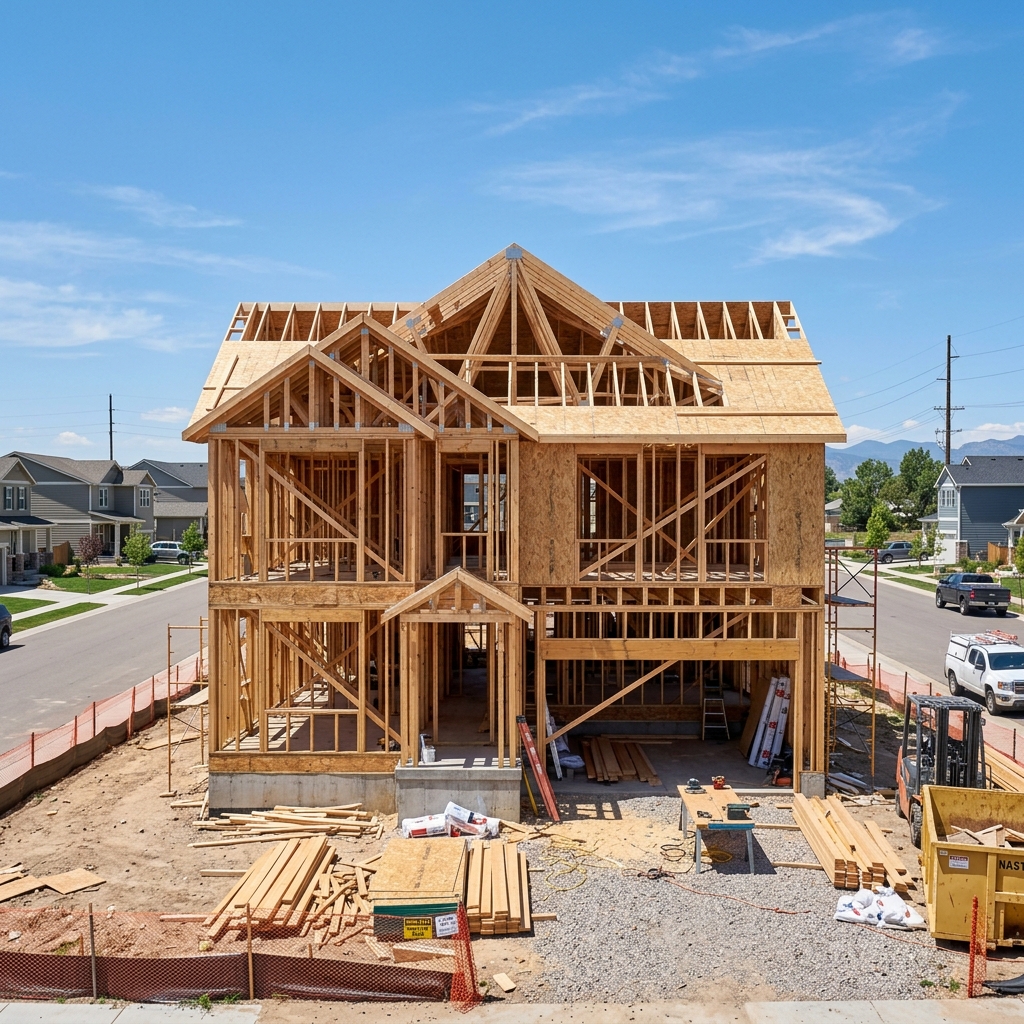





What Is a DSCR Rental Loan?
A DSCR rental loan is a long-term investment-property mortgage that qualifies on the property's debt-service coverage ratio — its rental income relative to the loan payment — rather than the borrower's personal income. DSCR stands for debt-service coverage ratio. These loans are for business or investment purposes only, sit in first-lien position, and are commonly used to buy and hold rental properties for cash flow.
How Do DSCR Loans Work?
A DSCR loan is underwritten by dividing the property's rental income by its total monthly debt payment — principal, interest, taxes, insurance, and any HOA dues — to produce the DSCR. A ratio of 1.0 means the rent exactly covers the payment; most lenders look for 1.0 to 1.2 or higher. Because approval rests on the property, there are no tax returns and no personal debt-to-income calculation. Terms typically run up to 30 years, with fixed and adjustable options.
DSCR Loan Rates, Points & Fees (2026)
Most DSCR loans carry an interest rate between 6.0% and 8.5% in 2026, with origination of 1 to 4 points. According to Lightning Docs, a loan-document software provider, the average DSCR loan on its platform in January 2026 priced near 7.04% on an average loan size of just over $319,000. Your rate depends on credit, LTV, the DSCR itself, and the prepayment structure you choose.
DSCR Loan Terms & Guidelines
Loan Amounts
Most DSCR lenders lend from about $75,000 to $2,000,000 on a single property, with portfolio and blanket loans reaching $20,000,000 or more across multiple units.
Loan-to-Value & Down Payment
On a purchase, DSCR LTV commonly reaches up to 80%, meaning roughly 20% down; cash-out refinances are usually capped near 75%.
Term & Payments
Most DSCR loans are 30-year fully amortizing mortgages. Lenders also offer 40-year options (ten years interest-only followed by a 30-year amortization) and 5/7/10-year ARMs.
Prepayment
DSCR loans typically carry a prepayment penalty, often a step-down such as 5-4-3-2-1 or 3-2-1; no-prepayment options are available at a higher rate.
DSCR Loan Requirements — Do You Qualify?
DSCR approval depends mainly on the property's cash flow and your credit, not your personal income. Lenders generally look for: a FICO of 680+ (some to 600); a DSCR the lender's program requires (often 1.0–1.2+); a 20–25% down payment or equivalent equity; several months of reserves; title held in an entity; and a rent-ready property (a signed lease is not always required).
DSCR Loan Scenarios
The most common DSCR scenarios are a turn-key rental purchase, a BRRRR refinance out of a short-term rehab loan, a cash-out refinance to fund the next acquisition, a portfolio (blanket) loan across several rentals, and financing for a short-term (Airbnb) rental.
DSCR vs. Conventional Financing
Choose a conventional mortgage for the lowest rate if you have clean income documentation and few financed properties; choose a DSCR loan to skip income verification, hold title in an entity, and scale past conventional property limits. For a landlord building a portfolio, DSCR is often the only practical path.
Pros and Cons of DSCR Loans
The main advantages of DSCR loans are no personal income documentation, no cap on the number of financed properties, entity vesting, and long-term fixed options; the main drawbacks are a higher rate than conventional, prepayment penalties, the need for positive cash flow, and a larger down payment.
How to Choose a DSCR Lender
The best DSCR lender for a deal is the one whose program fits your FICO band, property type (including short-term rentals and rural properties), prepayment preference, and market. Bring Capwell the scenario once, and we match it with DSCR lenders likely to fund it competitively so you can compare real terms.